
Everything You’ll Need
| Tool/Material | Carpet Tile | Stretch-In | Glue-Down | Purpose |
|---|---|---|---|---|
| Utility Knife | ✔ | ✔ | ✔ | Cut carpet/padding |
| Tape Measure | ✔ | ✔ | ✔ | Measure dimensions |
| Straight Edge | ✔ | ✔ | ✔ | Guide straight cuts |
| Chalk Line | ✔ | ✔ | ✔ | Mark layout lines |
| Pry Bar | ✔ | ✔ | ✔ | Remove baseboards/flooring |
| Knee Pads | ✔ | ✔ | ✔ | Protect knees |
| Tack Strips | ❌ | ✔ | Optional | Secure carpet edges |
| Double-Sided Tape | ✔ | ❌ | ❌ | Adhere carpet tiles |
| Carpet Adhesive | Optional | ❌ | ✔ | Glue carpet |
| Staple Gun | ❌ | ✔ | ✔ | Secure underlay (wood only) |
| Seaming Tape & Iron | ✔ | ✔ | ✔ | Join seams |
| Knee Kicker | ❌ | ✔ | ❌ | Stretch carpet |
| Power Stretcher | ❌ | ✔ | ❌ | Stretch carpet |
| Stair Tool | ✔ | ✔ | ✔ | Tuck carpet edges |
| Carpet Roller | ✔ | Optional | ✔ | Press carpet firmly |
For concrete subfloors: cement filler, construction adhesive, masonry nails.
Quick Notes:
- Carpet tiles often just need tape or adhesive dots and don’t require stretching.
- Stretch-in wall-to-wall carpet needs a knee kicker and power stretcher.
- Glue-down carpet skips the stretcher but requires adhesive and a roller to secure the bond.
Step 1: Removing Old Flooring
Before you put in new flooring, take out the old one. Get rid of things like old carpet or tile to have a fresh surface for your new floor.
Step 2: Subfloor Preparation
After removing the old flooring, clean and prepare the subfloor. Check for damage or moisture issues.
Fixing Damage and Uneven Spots
Find cracks, holes, or gaps that need filling. For a wooden subfloor, use wood filler and sand smooth once dry.
Use cement-based filler for cracks in concrete subfloors. Check for high or low spots and use a leveling compound to make the surface flat and smooth.
Fixing these issues prevents future problems in uneven spots.
Moisture Check
Test the subfloor for moisture, especially concrete. Too much moisture can cause mold and damage.
Use a moisture meter to check levels. If high, fix it before continuing.
Consider using a moisture barrier or sealant to keep it dry. Checking moisture ensures a lasting installation.
Step 3: Measuring the Room
Before buying flooring, measure the room’s size carefully. Measure both length and width. Don’t forget any special parts of the room’s shape.
Always add about 4 inches to your total length and width measurements for wall changes and cutting when fitting.
Handling Special Room Shapes
These shapes can make installation tricky and affect the look. Here are some common shapes:
Alcoves and Bay Windows
These can make special shapes and angles that change a room’s usual shape. They need exact measurements and extra flooring pieces for full coverage.
Closets and Doorways
Closets and doorways can break the flow of the main flooring. Doorways need special transitions between different floors, and closets may need smaller, custom pieces.
Angled Walls and Corners
Not all walls are straight. Angled walls and corners make cutting and fitting tricky. They need careful work so the flooring fits well.
Columns and Built-In Features
Columns or built-in items like shelves or fireplaces can be obstacles for flooring. These need exact cutting around their base for a smooth look.
Irregular Room Shapes
L-shaped or T-shaped rooms are harder to measure and cut. They need a careful approach to fit the flooring right.
Steps and Staircases
If there are steps or a staircase, each step needs its own measurement and flooring, ensuring a good fit between steps and the main floor.
Nooks and Crannies
Small nooks and recesses are easy to miss but important. They need to be measured and may need custom-cut pieces.
Step 4: Calculating Square Footage
After measuring, find the room’s square footage by multiplying the length and width. This tells you how much flooring you’ll need.
For instance, if your room is 10 by 20 ft, multiply 10 by 20 to get 200 sq ft.
Step 5: Installing Tack Strips
Tack strips are important for keeping the carpet edges secure on the floor. These strips have small nails that hold the carpet in place.
Tack Strips on Wood

To install tack strips on a wood floor, nail the strips down using a hammer or nail gun. Place the strips evenly around the room, leaving space between the strip and the wall.
Tack Strips on Concrete

Putting tack strips on concrete floors needs a different method.
First, put construction glue on the back of the tack strip and press it onto the floor. Then, secure it by nailing it with masonry nails.
Step 6: Choosing and securing the Right Underlay
The carpet pad, also called underlay, adds softness and insulation beneath your flooring. Lay it across the floor at a right angle to the direction of your flooring.
Types of Underlay
There are different underlays, each providing various comfort and support levels:
Foam Underlay
Foam underlay is popular because it is light and cheap. It gives a soft feeling when you walk and absorbs impact, perfect for busy areas.
Rubber Underlay
Rubber underlay is strong and lasts long. It offers great support and reduces noise, ideal for homes with multiple levels.
Felt Underlay
Felt underlay feels luxurious and absorbs sound well. Made from pressed fibers, it offers soft cushioning and helps make the home quieter.
Secure the Underlay
Use a staple gun to attach the underlay to the floor so it stays flat. Overlap the edges to hide any gaps or seams.
Factors to Consider when Choosing Underlayment
| Aspect | Consideration |
|---|---|
| Floor Type | Different floors may need different underlay for the best outcome. |
| Foot Traffic | Choose a dense underlay that can handle heavy use, like in hallways or living rooms. |
| Noise Reduction | Pick an underlay like rubber or felt to lower noise between floors and create a peaceful space. |
| Special Requirements | If using underfloor heating, select an underlay with good heat insulation for energy efficiency. |
Step 7: Cutting the Carpet
Installing Luxury Vinyl Flooring
Before putting down luxury vinyl flooring, make sure it fits the room well. Cutting it right is important for a good look. Here’s how to do it:
Measuring and Marking
- Start by unrolling the vinyl in the room where it will go.
- Leave a few extra inches along the walls for trimming.
- Use chalk or a pencil to mark measurements on the back. This will guide your cutting.
Techniques
- Straight cuts: Use a utility knife and a straightedge for long, straight cuts on the marked lines. Press down firmly for a clean cut.
- Corner cuts: For corners and angles, make diagonal cuts from the corner to ensure a smooth transition between walls.
- Trimming excess: After cutting main sections, trim any extra material along the edges with a utility knife. Make careful cuts for a neat finish.
Extra Tips
- Check your measurements again before cutting to avoid mistakes.
- Cutting needs precision and patience, so take your time.
- Change dull utility knife blades often for clean cuts.
- Cut away from your body and keep fingers clear of the blade for safety.
We offer financing options, and you can visit our showroom/store to see more.
Step 8: Stretching the Carpet
Flooring Installation
Use tools to fit the flooring tightly across the room. Start in the center and move toward the edges for a secure fit.
Finishing Touch
After installation, add a transition strip at doorways. This helps create a smooth change between rooms and keeps the flooring secure.
Step 9: Seaming Carpet
Luxury Vinyl Flooring
Luxury vinyl needs to be installed flat and smooth. Here are some tips for installing luxury vinyl:
- Use a tool to fit the vinyl into the edges. Start from the center and move out to the walls.
- Apply adhesive to the edges before joining them. This helps keep them secure.
- Use a roller to press the pieces together firmly. Roll from the center to the edges.
- If possible, avoid seams in busy areas. If necessary, make sure they go sideways to the main walking path.
DIY vs. Professional Carpet Installation
Before starting your project, think about whether to do it yourself or hire a professional.
| Option | Pros | Cons |
|---|---|---|
| DIY Installation | – Costs less upfront – Flexible timing – Feels rewarding | – Needs special tools – Hard to learn – Mistakes can be pricey (wrinkles, bad seams) |
| Professional Installation | – Perfect results – Quick and effective – May include warranty | – Costs more – Less flexible schedule |
DIY is best if:
- You’re working on small rooms.
- You have (or can rent) the right tools.
- You’re good at measuring and cutting.
Hire a pro if:
- The space is big or oddly shaped.
- You want results that last.
✅ Tip: Even if you DIY, hire a pro for tough tasks like stairs or tricky seams.
Need help with installation? Our flooring installation team handles everything from start to finish.
Get a free estimate today and make the process simple!
Common mistakes to avoid when installing carpet
Make sure to avoid common mistakes when installing flooring. Take your time with each step to ensure quality results.
- Improper seam preparation: Can lead to visible lines or gaps. Be sure to align and secure seams properly.
- Skipping subfloor cleaning and leveling: Results in uneven surfaces. Ensure the subfloor is clean, dry, and smooth.
- Inaccurate measurements: Might cause buying too much or too little material. Double-check dimensions and consider irregularities.
- Choosing the wrong underlay: Can affect durability and comfort. Select one that matches the flooring and room type.
- Improper tack strip installation: Can cause loose edges. Make sure tack strips are securely placed around the perimeter.
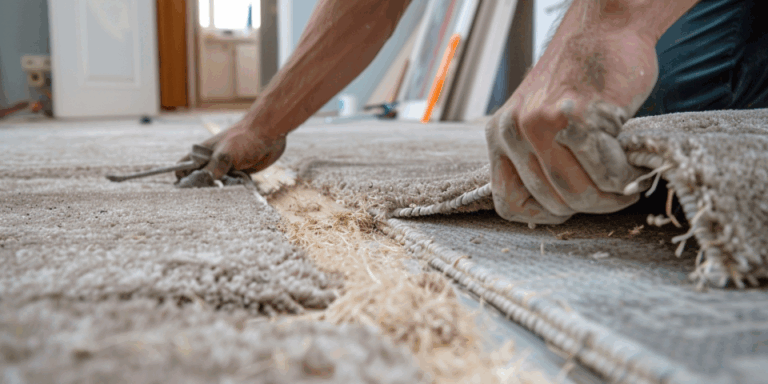
- Not stretching the flooring: Avoid wrinkles by using tools like a knee kicker or power stretcher for a tight fit.
- Ignoring room conditions: High humidity or temperature changes can cause issues. Prepare the room properly beforehand.
- No expansion gap at walls: Can lead to buckling. Leave a small gap between the flooring and walls for expansion.
We offer luxury vinyl, laminate, and tile flooring. Visit our showroom for more options and ask about our financing plans.
Do You Need Help With Your Carpet Installation Project?
Now that you’ve learned about flooring installation, you’re ready to improve your space. But if you’d like expert help, we’re here for you.
Our team can handle everything — from preparing the subfloor to precise installation — so you can relax and enjoy a perfect result. We’ll also help you pick the right style to fit your home and budget.
Contact us today to schedule your free in-home consultation and check if we serve your area.